Anonymous
×
Create a new article
Write your page title here:
We currently have 106 articles on MOR Wiki. Type your article name above or click on one of the titles below and start writing!


MOR Wiki

Synthetic parametric model

Revision as of 21:38, 5 April 2018 by Werner (talk | contribs) (Rewritten first sections, added planned sections.)


Description

Error creating thumbnail: Unable to save thumbnail to destination
Poles of synthetic parametric system, for parameter values 1/50 (blue), 1/20 (green), 1/10 (red), 1/5 (teal), 1/2 (purple), 1 (yellow).

On this page you will find a synthetic parametric model with one parameter for which one can easily experiment with different system orders, values of the parameter, as well as different poles and residues. Also, the decay of the Hankel singular values can be changed indirectly through the parameter.

Model

We consider a dynamical system in the frequency domain given by its pole-residue form of the transfer function

\[ \begin{align} H(s,\varepsilon) & = \sum_{k=1}^{n}\frac{r_{k}}{s-p_{k}}\\ & = \sum_{k=1}^{n}\frac{r_{k}}{s-(\varepsilon a_{k} + jb_{k})}, \end{align} \]

with \(p_{k} = \varepsilon a_{k} + jb_{k}\) the poles of the system, \(j\) the imaginary unit, and \(r_{k}\) the residues. The parameter \(\varepsilon\) is used to scale the real part of the system poles. We can write down the state-space realization of the system's transfer function as

\[ \begin{align} H(s,\varepsilon) = \widehat{C}(sI_{n} - (\varepsilon \widehat{A}_{\varepsilon} + \widehat{A}_{0}))^{-1}\widehat{B}, \end{align} \]

with the corresponding system matrices \(\widehat{A}_{\varepsilon} \in \mathbb{R}^{n \times n}\), \(\widehat{A}_{0} \in \mathbb{C}^{n \times n}\), \(\widehat{B} \in \mathbb{R}^{n}\), and \(\widehat{C}^{T} \in \mathbb{C}^{n}\) given by

\[ \begin{align} \varepsilon\widehat{A}_{\varepsilon} + \widehat{A}_{0} & = \varepsilon \begin{bmatrix} a_{1} & & \\ & \ddots & \\ & & a_{n} \end{bmatrix} + \begin{bmatrix} jb_{1} & & \\ & \ddots & \\ & & jb_{n} \end{bmatrix},\\ \widehat{B} & = \begin{bmatrix}1, & \ldots, & 1 \end{bmatrix}^{T},\\ \widehat{C} & = \begin{bmatrix}r_{1}, & \ldots, & r_{n} \end{bmatrix}. \end{align} \]

One notices that the system matrices \(\widehat{A}_{0}\) and \(\widehat{C}\) have complex entries. For rewriting the system with real matrices, we assume that \(n\) is even, \(n=2m\), and that all system poles are complex and ordered in complex conjugate pairs, i.e.,

\[ \begin{align} p_{1} & = \varepsilon a_{1} + jb_{1},\\ p_{2} & = \varepsilon a_{1} - jb_{1},\\ & \ldots\\ p_{n-1} & = \varepsilon a_{m} + jb_{m},\\ p_{n} & = \varepsilon a_{m} - jb_{m}. \end{align} \]

Corresponding to the system poles, also the residues are written in complex conjugate pairs

\[ \begin{align} r_{1} & = c_{1} + jd_{1},\\ r_{2} & = c_{1} - jd_{1},\\ & \ldots\\ r_{n-1} & = c_{m} + jd_{m},\\ r_n & = c_{m} - jd_{m}. \end{align} \]

Using this, the realization of the dynamical system can be written with matrices having real entries by

\[ \begin{align} A_{\varepsilon} & = \begin{bmatrix} A_{\varepsilon, 1} & & \\ & \ddots & \\ & & A_{\varepsilon, m} \end{bmatrix}, & A_{0} & = \begin{bmatrix} A_{0, 1} & & \\ & \ddots & \\ & & A_{0, m} \end{bmatrix}, & B & = \begin{bmatrix} B_{1} \\ \vdots \\ B_{m} \end{bmatrix}, & C & = \begin{bmatrix} C_{1}, & \cdots, & C_{m} \end{bmatrix}, \end{align} \]

with \(A_{\varepsilon, k} = \begin{bmatrix} a_{k} & 0 \\ 0 & a_{k} \end{bmatrix}\), \(A_{0, k} = \begin{bmatrix} 0 & b_{k} \\ -b_{k} & 0 \end{bmatrix}\), \(B_{k} = \begin{bmatrix} 2 \\ 0 \end{bmatrix}\), \(C_{k} = \begin{bmatrix} c_k, & d_k \end{bmatrix}\).

Numerical Values

We construct a system of order \(n = 100\). The numerical values for the different variables are

  • \(a_i \) equally spaced in \( [-10^3, -10]\),
  • \(b_i \) equally spaced in \([10, 10^3]\),
  • \( c_i = 1\),
  • \( d_i = 0\),
  • \(\varepsilon\)\( \in [1/50,1]\).


In MATLAB, the system matrices are easily formed as follows:

 n = 100;
 a = -linspace(1e1,1e3,n/2).';   b = linspace(1e1,1e3,n/2).';
 c = ones(n/2,1);                d = zeros(n/2,1);
 aa(1:2:n-1,1) = a;              aa(2:2:n,1) = a;
 bb(1:2:n-1,1) = b;              bb(2:2:n-2,1) = 0;
 Ae = spdiags(aa,0,n,n);
 A0 = spdiags([0;bb],1,n,n) + spdiags(-bb,-1,n,n);
 B = 2*sparse(mod([1:n],2)).';
 C(1:2:n-1) = c.';               C(2:2:n) = d.';   C = sparse(C);


The above system matrices \(A_\varepsilon, A_0, B, C\) are also available in MatrixMarket format Synth_matrices.tar.gz.

Plots

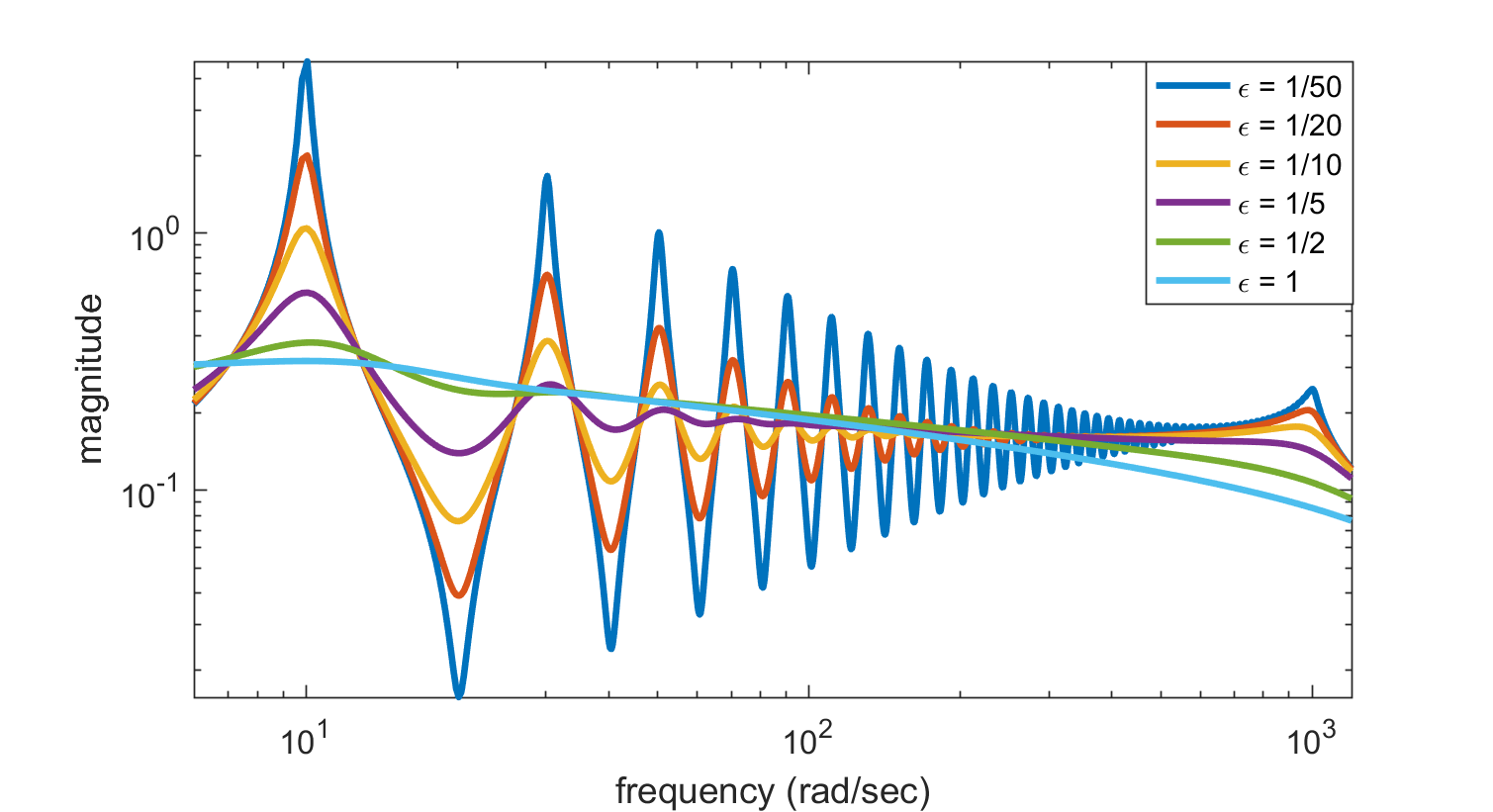
We plot the frequency response \(H(s,\varepsilon) = C\big(sI-\varepsilon A_\varepsilon - A_0\big)^{-1}B\) and poles for parameter values \(\varepsilon \in [1/50, 1/20, 1/10, 1/5, 1/2, 1] \).


Error creating thumbnail: Unable to save thumbnail to destination
Frequency response of synthetic parametric system, for parameter values 1/50 (blue), 1/20 (green), 1/10 (red), 1/5 (teal), 1/2 (purple), 1 (yellow).


In MATLAB, the plots are generated using the following commands:

 r(1:2:n-1,1) = c+1j*d;     r(2:2:n,1) = c-1j*d;
 ep = [1/50; 1/20; 1/10; 1/5; 1/2; 1];                       % parameter epsilon
 jw = 1j*linspace(0,1.2e3,5000).';                           % frequency grid
 for j = 1:length(ep)
   p(:,j) = [ep(j)*a+1j*b; ep(j)*a-1j*b];                    % poles
   [jww,pp] = meshgrid(jw,p(:,j));
   Hjw(j,:) = (r.')*(1./(jww-pp));                           % freq. resp.
 end
 figure,  loglog(imag(jw),abs(Hjw),'LineWidth',2)
          axis tight,    xlim([6 1200])
          xlabel('frequency (rad/sec)')
          ylabel('magnitude')
          title('Frequency response for different \epsilon')
 figure,  plot(real(p),imag(p),'.')
          title('Poles for different \epsilon')


Other interesting plots result for small values of the parameter. For example, for \(\varepsilon = 1/100, 1/1000 \), the peaks in the frequency response become more pronounced, since the poles move closer to the imaginary axis.


Next, for \(\varepsilon \in [1/50, 1/20, 1/10, 1/5, 1/2, 1] \), we also plot the decay of the Hankel singular values. Notice that for small values of the parameter, the decay of the Hankel singular values is very slow.

Error creating thumbnail: Unable to save thumbnail to destination
Hankel singular values of synthetic parametric system, for parameter values 1/50 (blue), 1/20 (green), 1/10 (red), 1/5 (teal), 1/2 (purple), 1 (yellow).

Data

Dimensions

Citation

Contact

Antonio Cosmin Ionita